

Childhood games and shared stories: where Hong Kong’s past meets its future

Dr Izzy Jian Yi from SSPS, far left, Chloe Lee Sum-yee, centre, and Esther Lam Hiu-tung picture at one corner of Tai Kok Tsui.

Built in the early 1980s, Fu Tor Loy Shopping Centre was Tai Kok Tsui’s landmark shopping arcade. It once stood just one street away from the Yau Ma Tei Typhoon Shelter. That part of the shelter is later reclaimed and becomes today’s Olympic MTR Station and Olympian City.
“I never visited Tai Kok Tsui even though I was born and grew up in Hong Kong. Because of the project, I had the chance to take a closer look at that part of old Hong Kong. Its many tenement buildings, hardware shops, small family-run stores, eateries, and groceries exude a strong sense of community. Elderly residents taught me about childhood games from the past, such as marbles, cartoon papers, and beanbags. This experience broadened my understanding of old-time Hong Kong,” said Chloe Lee Sum-yee, a student of the Bachelor of Social Sciences (Honours) in Sociology and Community Studies (BSocSc(SCS)) programme.
To strengthen their skills in designing and running community engagement activities and apply classroom knowledge in real-world situations, all students of the BSocSc(SCS) programme must complete a community-based capstone project before graduation, either in a team or individually. Chloe’s team, which included Jessica Ku Hei-ching, Oscar Chan Tsz-hin, Matthew Li Yin-kai, Esther Lam Hiu-tung, and Ada Loi Yee-tung, designed a project to provide recreational and social activities for elderly residents in Tai Kok Tsui.

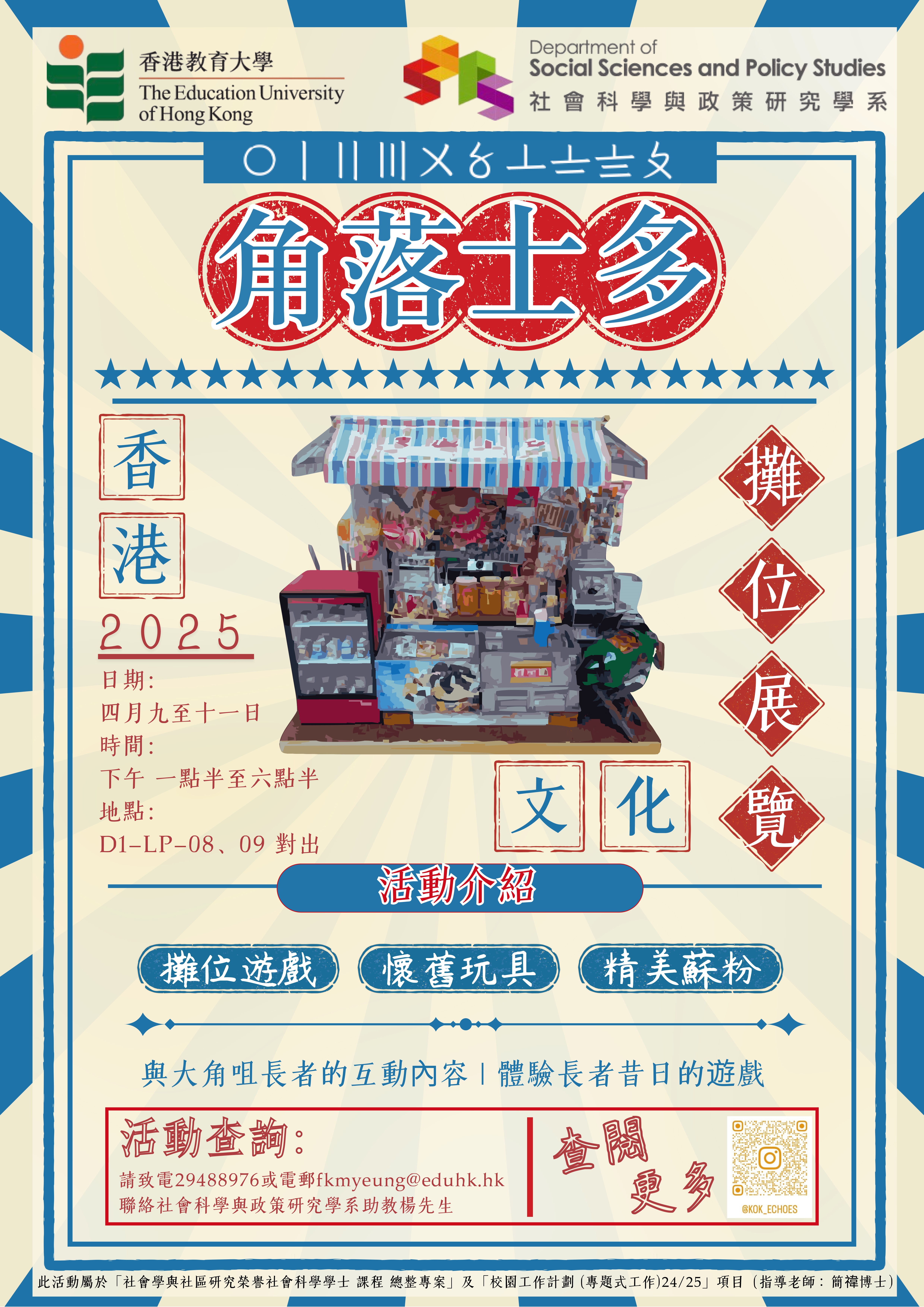
To share their project findings with the EdUHK community, the project team organises a mini exhibition in April.
In February and March, the group organised five outreach activities in the district. These included a one-day community trip, a dyeing workshop, boardgame time, a mobile phone lesson, and a campus visit to EdUHK with a weaving class. On average, around 10 elderly residents joined each event. In May, the team held a community exhibition in Tai Kok Tsui to showcase findings and share experiences. Earlier, a mini exhibition took place in April, followed by the final exhibition in October at EdUHK’s Tai Po campus.

Mr Law, left, with his new phone case, and his neighbour Mrs Leung, middle, pose with Chole at the community exhibition held in Tai Kok Tsui. Mr Law says he learnt how to decorate his phone case at the mobile phone lesson.

A participant shares fond memories from the five project activities with Esther Lam Hiu-tung outside the community exhibition.
Quote: We had a lot of fun when we played charades (大電視) during boardgame time. The games brought us together.
“Among all activities, I most enjoyed the EdUHK campus visit. It was my first time seeing a university, and I found the spacious campus with its many buildings, library, dormitories, and canteen, a truly enjoyable place to explore,” said Mr Law at the community exhibition. Mr Law and his neighbour Mrs Leung joined the project starting from the second activity. They loved every session and often shared their fun experiences with friends and family.
Mr Law and Mrs Leung have lived in Tai Kok Tsui for forty years. For many seniors like them, who spent much of their lives working and raising children, retirement provides time to explore new interests. “They were very nice to us, reminding us to be careful when boarding and getting off the coaches. Chloe, Esther and the other young people from EdUHK are like my children and even grandchildren. We had a lot of fun when we played charades (大電視) during boardgame time. The games brought us together,” Mrs Leung recalled joyfully.

Participants proudly display their completed work at the weaving workshop. Brother Tony is on the far right on the back row. On the front row are the members of the capstone project, from second from left to second from right: Oscar Chan Tsz-hin, Chloe Lee Sum-yee, Ada Loi Yee-tung, Esther Lam Hiu-tung, Jessica Ku Hei-ching, and Matthew Li Yin-kai.

At the weaving workshop, Chole, left, shows Mr Law, centre, and Mrs Leung, right, how to weave threads into cloth.
We used soft drink bottle caps, flattened them, drilled a small hole in the centre, and threaded a string through. The fun came when we spun the lid by pulling the string.
Alongside the activities, the students interviewed participants about their childhood games. “We grew up in a resource deprived Hong Kong. Many parents of my generation couldn’t afford toys. But a child’s imagination knows no limits, so we made our own. For example, we used soft drink bottle caps, flattened them, drilled a small hole in the centre, and threaded a string through. The fun came when we spun the lid by pulling the string,” said Mr Lau, affectionately called Brother Tony by the students.
Brother Tony attended all five activities and was impressed by the students. “They are polite and friendly. They showed genuine interest in us, in Tai Kok Tsui and in Hong Kong’s past. While we shared old stories with them, I also learnt new ideas and trends from them. These intergenerational interactions are very valuable. They help us learn from one another and keep society connected. We are friends now. I still exchange messages with them even though the project has officially ended,” he said.

A child visits the community exhibition.

Plastic swords, cartoon papers and glass marbles are on display at the community exhibition. These toys were once hugely popular a few decades ago.
Tai Kok Tsui remains a close-knit community with many small shops. Neighbourhoods like this are rare in Hong Kong today.
Chloe reflected that the age gap did not prevent meaningful conversations. “They told me many things I didn’t know. For example, the site where Olympic Station and Hoi Fai Road Promenade now stand used to be part of the Yau Ma Tei Typhoon Shelter, right next to Tai Kok Tsui. Because of the project, I visited the area many times and spoke with its long-time residents. I found that although there are now modern developments and chic bistros, Tai Kok Tsui remains a close-knit community with many small shops. Neighbourhoods like this are rare in Hong Kong today,” Chloe said.
Dr Izzy Jian Yi, Assistant Professor in the Department of Social Sciences and Policy Studies, supervised Chloe’s team throughout the project. “Students learnt stories from residents that are not recorded in textbooks. They gained a deeper understanding of what makes the community unique. They also experienced what community dynamics and social networks mean in practice. This will serve them well whether they become community workers, teachers or pursue academic research,” Dr Jian said.
